Why build an AI trainer for medical conversations?
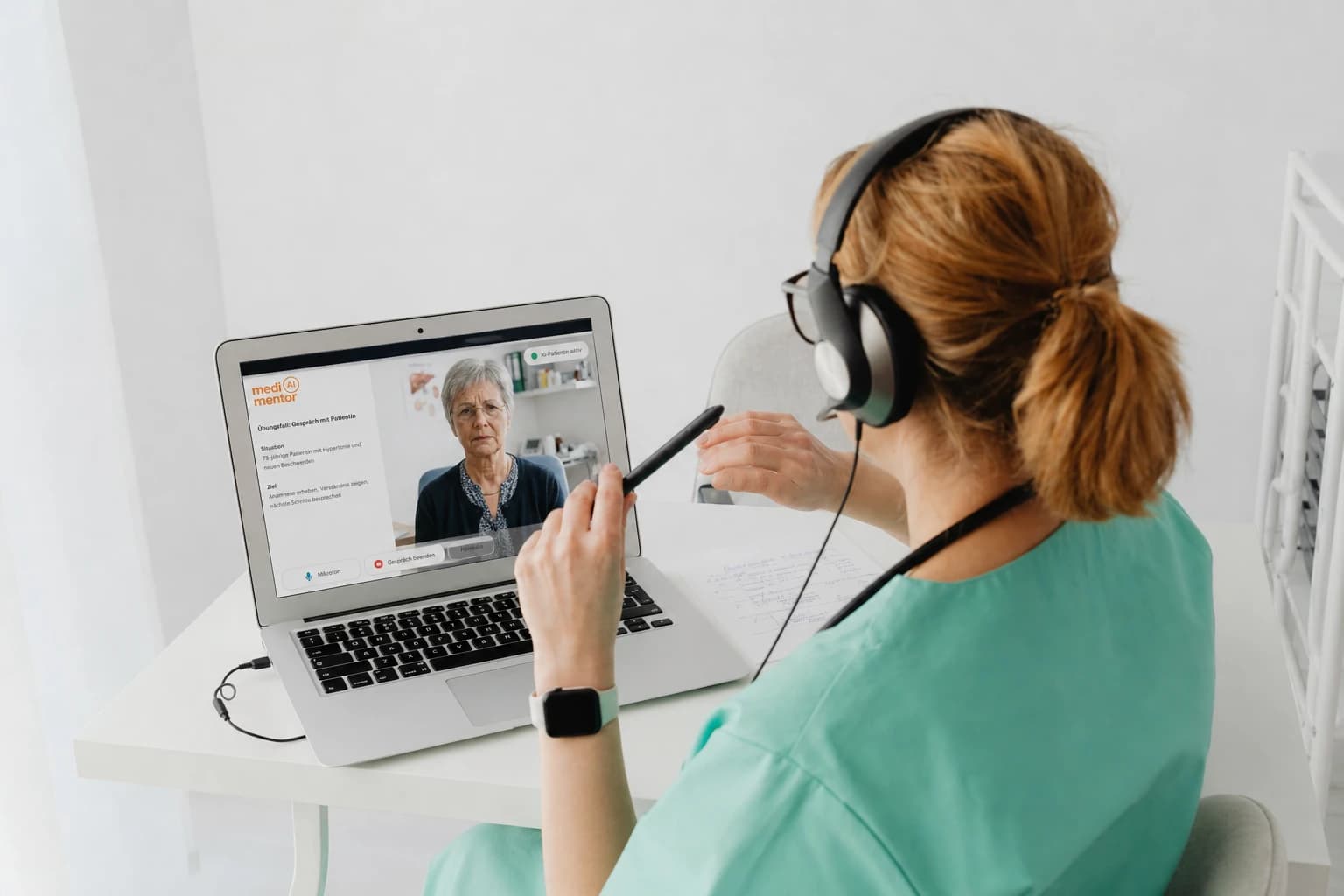
Communication is an examined subject in medical school — and in clinical practice it's among the most common sources of complaints, misunderstandings and abandoned treatment. Until now it has been trained with simulated patients: didactically excellent, but expensive, staff-intensive, and available only a handful of times across an entire degree. The result: doctors in training practise the hardest conversation of their profession — delivering a bad diagnosis, handling a frightened or hostile patient — for the first time on a real patient. medi mentor closes that gap: training that can be repeated as often as needed, at any hour, with structured feedback.
The project partners
The MLU medical faculty and university hospital, with over 300 years of history and among the leading centres for medical research and teaching in central Germany. Contributes the general practice and didactic expertise.
Through its Institute of Information Systems: expertise in digital innovation, AI technologies and scientific evaluation.
Method, AI engineering and practical delivery: turning research findings into an application students will actually use.
Who is medi mentor for?
Who want to practise consultations as often as they need to — not as often as the budget for simulated patients allows.
Particularly in general practice, who will one day have to deliver a serious diagnosis for the first time and would rather not do it cold.
Who want to scale communication training without giving up didactic quality — and who need to be able to trace what a piece of feedback was based on.
What we're researching
medi mentor is a research project, not a finished product — and the interesting questions are still open. Can a language model hold a patient role consistently enough for learners to take it seriously? Can conversational quality be assessed automatically in a way that is didactically defensible rather than merely plausible? And what happens to the learning curve when you can run a conversation not once but twenty times? The answers come from the combination: method and AI engineering from futurest, medical and didactic expertise from our partners in Halle.
Where the project stands: The prototype is complete. Next comes the testing phase with medical students and doctors in specialist training — that's where it will become clear whether the simulation delivers what it promises. Further results will be shared from September 2026.
Why futurest works on this
Because medi mentor brings together what we usually do separately: the methodological understanding of how people learn and communicate — and the engineering ability to turn that into an AI product that works in practice. What we learn here about simulation, role consistency and automated assessment flows back into AIDGEN and into our client work.